

Three Doors Cave in Santa Maria di Leuca
Along the West side, where the Ionian coast shatters into vertical cliffs and hidden inlets, lies one of the most photographed scenes in all of Leuca. The Three Doors Cave (Grotta delle Tre Porte) owes its name to the three natural arches that form its entrance—a monumental portal carved by the sea and wind over millennia. Seen from the sea, the cave appears like the facade of an ancient palace, with three openings framing the deep blue of the Ionian Sea.
A gateway to prehistory
While the three arches are striking for their grandeur, it is what they guard inside that makes this cave truly extraordinary. In the cavity opening beyond the entrances lies the so-called “Child’s Cave” (Grotta del Bambino), an inner chamber where archaeologists have unearthed findings of exceptional importance. Fossil remains of an elephant and a rhinoceros bear witness to an era when Salento was very different from how we know it today, featuring a tropical climate and fauna long gone from the European continent.

The most significant find, however, is a human tooth dating back to the Neanderthal era—one of the few pieces of evidence of this species’ presence in the far south of Puglia. Alongside the tooth, excavations revealed worked flint tools, instruments that tell the daily story of prehistoric communities who used these caves as shelter and living space. The name “Child’s Cave” comes directly from the age of that tooth’s owner: a young individual, perhaps a child, who lived tens of thousands of years ago on this very stretch of coast.
Natural architecture
The three arches that give the cave its name are not merely holes in the rock. Each has a different size and shape, creating a play of perspectives that changes completely depending on the angle of observation. Approaching by boat, the first arch appears wider and brighter, while the two side ones are revealed gradually, unveiling the depth of the cavity behind them. Inside, light filters through the three openings, creating contrasts of shadow and azure that make this spot a favorite for photographers.
The cave walls display the geological layers of the limestone rock, with shades ranging from pure white to warm gray, interrupted by iron oxide veins that draw irregular patterns on the surface. In some areas, small stalactites hang from the vault—a sign that fresh water continues its slow work of sculpting even today.
How to visit the Three Doors Cave
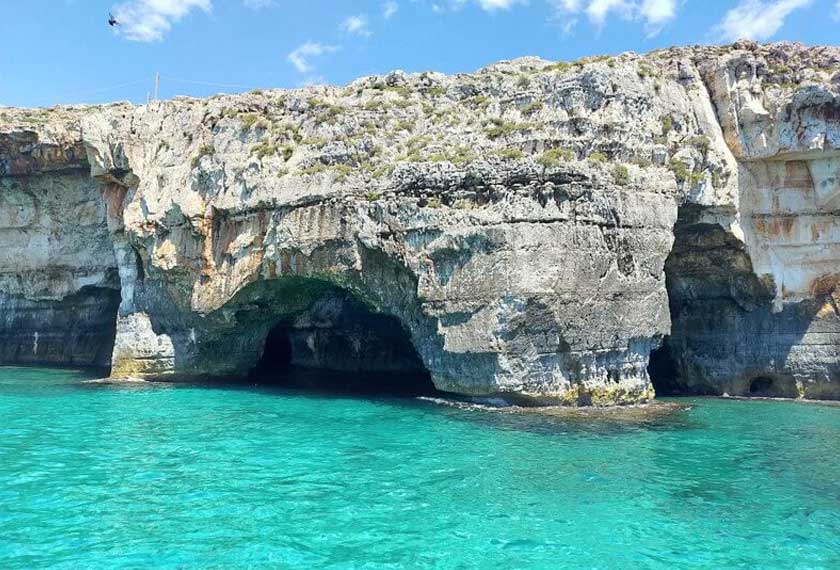
The Three Doors Cave is located on the West side (Ponente) and is accessible exclusively by sea. Its generous dimensions allow boats to approach almost to the interior of the arches, offering a close-up perspective that no photo can fully capture. The 1 hour and 30-minute boat tour along the West side includes an extended stop in front of the three arches, while the complete 3-hour tour allows you to combine the visit with other caves on both sides.
Those who prefer a more intimate experience can opt for an exclusive excursion with a private boat, ideal for staying longer and swimming in the turquoise waters surrounding the base of the arches. The best conditions for a visit are during the central morning hours, when sunlight penetrates frontally through the openings, illuminating the entire cavity.
Frequently Asked Questions about the Three Doors Cave
Why is it called Three Doors Cave?
The name comes from the three natural arches that form the entrance to the cave, formations carved by marine erosion over millennia. Seen from the sea, they resemble the doors of an ancient palace.
Can you go inside the cave?
Yes, boats can approach almost to the inside of the arches. During excursions, it is also possible to swim in the crystal-clear waters in front of the cave.
What are the prehistoric findings of the Child’s Cave?
Inside the Three Doors Cave lies the Child’s Cave (Grotta del Bambino), where fossils of elephants and rhinoceroses, flint tools, and a human tooth from the Neanderthal era were found.
Where do the excursions depart from?
All excursions depart from the Port of Santa Maria di Leuca. The meeting point is the Bar del Porto, with a recommended arrival time of 15-30 minutes before departure.
The Three Doors Cave is part of the sea caves of Santa Maria di Leuca, a system of coastal cavities extending along both sides of the Iapygian promontory.