

Cammino del Salento: Complete Guide to the Stages and What to Do in Santa Maria di Leuca
From Lecce to the southernmost tip of Puglia, where the land ends and the sea begins. The Cammino del Salento is a slow journey across the Salento Peninsula, ending in Santa Maria di Leuca, where the Adriatic and Ionian Seas meet beneath the Sanctuary of De Finibus Terrae.
What is the Cammino del Salento?
The Cammino del Salento is a long-distance hiking trail that crosses the far south of Puglia, starting from Lecce and ending in Santa Maria di Leuca. Created to promote the Salento area, the route is divided into two main itineraries: the Sea Route and the Villages Route. They separate in Lecce, meet again in Otranto and then continue together towards the final destination.
The starting point is Porta Napoli in Lecce, a Baroque triumphal arch that marks the entrance to the historic centre. From there, after crossing Piazza Sant’Oronzo, the two routes split: left towards the Castle for the Sea Route, right towards Porta San Biagio for the Villages Route.
- Starting point: Porta Napoli, Lecce
- Finish: Sanctuary of De Finibus Terrae, Santa Maria di Leuca
- Sea Route: 115 km · 5 stages · coastal route
- Villages Route: 135 km · 6 stages · inland and coastal route (closed in 2026)
- Trail signs: orange arrows · downloadable GPX tracks
- Pilgrim Passport: available on the official website
- Official website: camminodelsalento.it
⚠️ 2026 update: The Villages Route is temporarily closed for route improvement works. In 2026, only the Sea Route is open. Always check the official Cammino del Salento website for the latest updates.
The Sea Route — 5 stages along the Adriatic Coast
The Sea Route is the best option for those who want to experience coastal Salento from the very first day. With 115 km divided into 5 stages, it reaches the Adriatic Sea at the end of the first walking day. Along the way, the landscape changes constantly: Aleppo pine forests, rocky cliffs, white beaches and small seaside villages.
Stage 1 — Lecce → San Foca (25 km · 6 hours)
The trail starts from Porta Napoli and crosses the historic centre of Lecce, passing the Basilica of Santa Croce and Piazza Sant’Oronzo. From there, it continues through the countryside, the fortified village of Acaya, the Cesine Nature Reserve and the first stretch of Adriatic coastline, all the way to the seafront of San Foca.
Stage 2 — San Foca → Otranto (24.6 km · 6.5 hours)
One of the most scenic stages of the entire route. You pass the Archaeological Park of Roca Vecchia, the sea stacks of Torre Sant’Andrea, Baia dei Turchi and the Alimini Lakes. The destination is Otranto, with its Aragonese castle and Norman cathedral, famous for its medieval floor mosaic.
Stage 3 — Otranto → Santa Cesarea Terme (22.6 km · 6 hours)
A spectacular coastal trekking stage. Highlights include Punta Palascìa Lighthouse, the easternmost point of Italy, and Porto Badisco, traditionally linked to the legendary landing of Aeneas. The route continues past freshwater springs that flow into the sea and reaches the Art Nouveau architecture of Santa Cesarea Terme.
Stage 4 — Santa Cesarea Terme → Marina Serra (24 km · 6.5 hours)
This stage passes through Castro, with its medieval historic centre, the Acquaviva inlet with its cold freshwater springs, and Tricase Porto, awarded the 3 Sails by Legambiente. The arrival point is Marina Serra, known for its beautiful natural swimming pool carved into the rock.
Stage 5 — Marina Serra → Santa Maria di Leuca (21.7 km · 5 hours)

The final stage is one of the most emotional. You walk past coastal towers, hidden coves and natural pools, with the cliffs accompanying you all the way south. The arrival in Santa Maria di Leuca, followed by the climb up the 284 steps to the Sanctuary of De Finibus Terrae, is an unforgettable moment: the place where Italy ends.
“284 steps separate the arrival at the foot of the monumental waterfall from the Sanctuary of De Finibus Terrae — the final destination of the Cammino del Salento, where Italy gives way to the meeting of the two seas.”
Landscapes and places that will surprise you
The Cammino del Salento is one of the few walking routes in Italy where the landscape changes dramatically in just a few days. You start from the flat countryside around Lecce, walk through ancient olive groves and dry-stone walls, follow the wilder side of the Adriatic and finally reach the dramatic cliffs of the southern cape.
The Adriatic cliffs
From the second stage onwards, the sea is almost always present. The sea stacks of Torre Sant’Andrea, the cliffs of Castro, the marine caves around Tricase — every section reveals a less crowded and more authentic side of Puglia. The water shifts from emerald green to deep blue.
Medieval villages
Otranto with its cathedral and Aragonese castle, Castro with its narrow historic streets, Santa Cesarea Terme with its Art Nouveau villas overlooking the sea — the route crosses villages that deserve more than just an overnight stop.
Mediterranean scrub
Between one stage and the next, you walk through vegetation scented with rosemary, myrtle and mastic. In spring, the flowering of rockroses and asphodels turns the trails into colourful natural corridors.
Recommended accommodation along the route
The Cammino del Salento has a network of partner accommodations offering discounts to walkers with the Pilgrim Passport.
- Lecce: many B&Bs in the historic centre, several of them partnered with the route
- Otranto: hostels and B&Bs in the centre, ideal after the second stage
- Santa Cesarea Terme: spa hotels and guesthouses — a welcome comfort after the longer stages
- Marina Serra: small sea-view accommodations, perfect for the last night before Leuca
- Santa Maria di Leuca: hotels, B&Bs and holiday homes for those who want to stay a few extra days
The Pilgrim Passport can be purchased on the official website camminodelsalento.it and gives access to discounts in partner accommodations. At the end of the walk, you can receive the Testimonium, the final certificate, similar to the one issued on the Camino de Santiago.
Practical information
When to go
The best periods are March to May and September to October. Spring offers blooming countryside and mild temperatures. Autumn brings warm sea temperatures and fewer tourists. July and August are not recommended because of the heat.
How to get to Lecce
Lecce can be reached by train with Trenitalia and Italo. From Rome, the journey takes around 4 hours by high-speed train; from Milan, around 7 hours. The nearest airport is Brindisi, about 45 minutes away, with flights from many major Italian and European cities.
What to pack
Bring trekking shoes with a strong sole, telescopic walking poles, SPF 50+ sunscreen, a first-aid kit with blister plasters and layered clothing. Ideally, your backpack should not exceed 10 kg. The luggage transport service along the route allows you to walk lighter.
You walked all the way to the end. Now the sea is waiting.
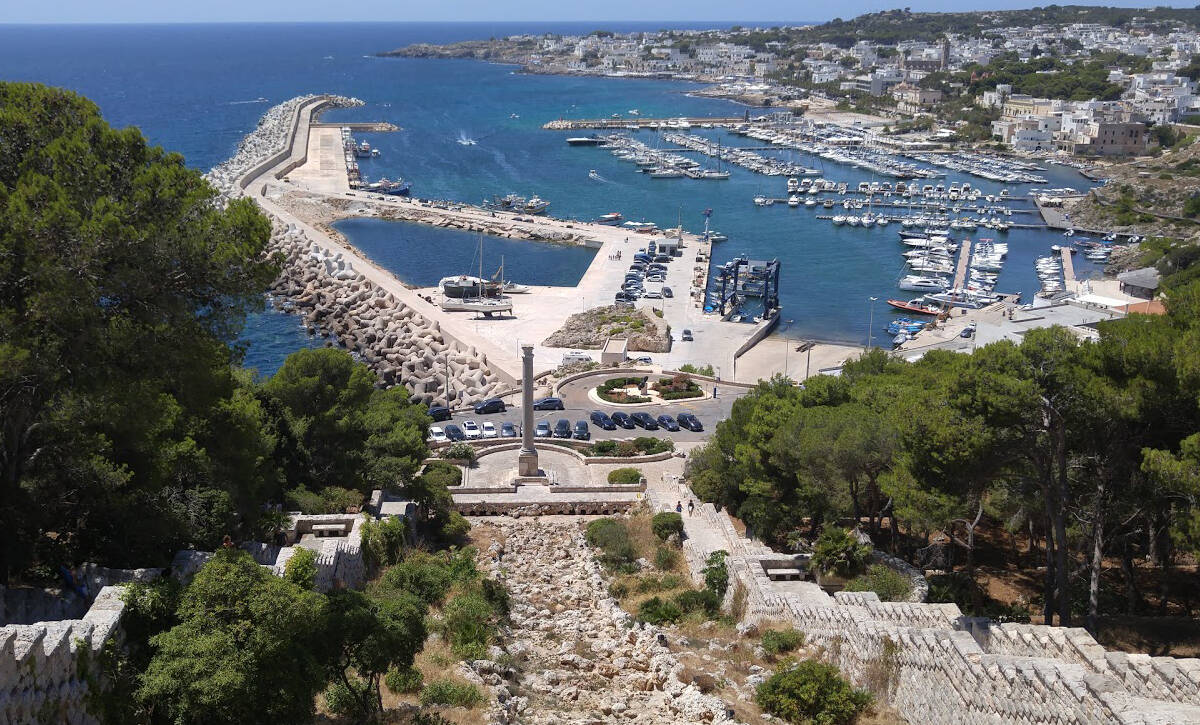
You arrive in Santa Maria di Leuca after days of walking, climb the 284 steps to the Sanctuary and look out over the point where the Adriatic and Ionian Seas meet. And then?
The same cliffs you followed on foot look completely different from the sea. The marine caves of Leuca can only be fully appreciated from the water — from land, many of them are not visible at all. Many walkers, after days of trekking along this coastline, choose to experience it from the sea as well. That is exactly what our boat tours are designed for.
- 1h30 Cave Tour — from €20 · the essential option, perfect on the day of arrival
- 3-Hour Tour — Adriatic + Ionian — from €40 · both sides of the coast and all the main caves
- Sunset Boat Tour — from €35 · the perfect toast after the walk, with a Salento aperitif included
Book the day before your arrival, especially in summer. Places fill up quickly, and you deserve to end the walk in the best possible way.
Santa Maria di Leuca — what to do after the walk
The Sanctuary of De Finibus Terrae
The final destination of the route. According to tradition, Saint Peter landed here before bringing the Gospel to Italy. The sanctuary stands on the site of an ancient Roman temple dedicated to Minerva. The climb is worth it for the view over the two seas.
The monumental waterfall
A historic aqueduct that flows into the sea through an artificial waterfall, illuminated in the evening on selected dates. It is one of the symbols of Leuca and the visual arrival point of the route.
The marine caves
There are more than 40 marine caves along the coast of Leuca, including the Devil’s Cave, the Three Doors Cave, the Breath Cave and Dragon Cave. Most of them can only be reached by boat.
Le grotte e le scogliere di Santa Maria di Leuca si vedono al meglio dall'acqua. Scopri le nostre escursioni in barca alle grotte e vivi il Salento da un'altra prospettiva.